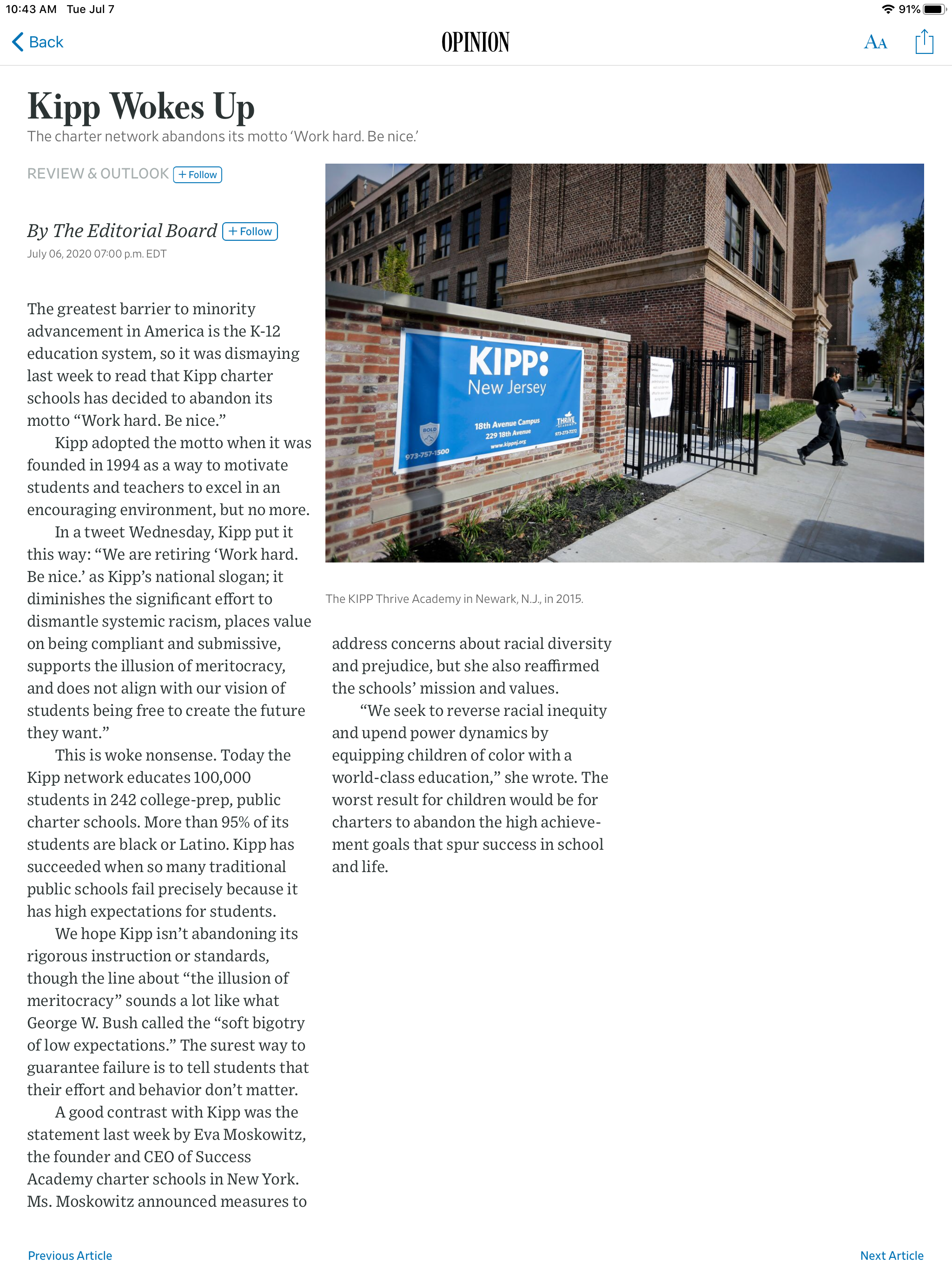
A few days ago I wrote in a blog entitled The Dark Side of Nice about the concept of “Minnesota Nice” and how I saw niceness as a barrier to acknowledging systemic racism.
In an interesting coincidence, a recent Wall Street Journal editorial addressed this same topic, but in a much different way. The editorial focused on a decision by the KIPP Public Charter Schools, where 95% of the roughly 100,000 students in 242 college-prep, public schools are Black or Latino. Their decision was to drop the national slogan they had used since 1994; “Work Hard. Be Nice.” Their explanation was that the slogan “diminished the significant effort to dismantle systemic racism, places value on being compliant and submissive, supports the illusion of meritocracy, and does not align with our vision of students being free to create the future they want.”
To me, this made complete sense. It was similar to my argument about “Minnesota Nice.” It also is consistent with the research on niceness, most notably Angelina Castagno’s 2014 book entitled Whiteness: Good Intentions and Diversity in Schools. Castagno talks about “niceness” being conceptually and practically linked to “whiteness.” She says; “a nice person is not someone who creates a lot of disturbance, conflict, controversy, or discomfort. Nice people avoid potentially uncomfortable or upsetting experiences, knowledge, and interactions, and niceness compels us to reframe potentially disruptive or uncomfortable things in ways that are more soothing, pleasant, and comfortable.”
My point in bringing this up is not to prove I was right. The reason I’m writing about it is that the Wall Street Journal editorial board got it wrong. They called dropping the slogan “woke nonsense” and added: “We hope Kipp isn’t abandoning its rigorous instruction or standards…The surest way to guarantee failure is to tell students that their effort and behavior don’t matter.”
Wow. The editorial board totally missed the point. It wasn’t the “work hard” part that needed to go, it was the “be nice” part. I wonder whether anyone challenged the editorial board’s assumption or spoke up to say “maybe this is about how being nice gets in the way of speaking up and calling out racist practices, or interrupting patterns of prejudice.” Did anyone point out the specific anti-racist language that was used in the explanation for dropping the motto?
This is the challenge of anti-racism. Some say, for white people, it involves getting past white shame and guilt, but as I expressed in previous posts, it can also be about removing the barriers of pride and arrogance in correctness, and stopping being nice. For whites, anti-racism requires being humble, and really thinking critically about how race matters in seemingly nonracial contexts, like, for instance, in the context of “nice.”
I have written a letter to the editor of the Wall Street Journal expressing my views. I’m guessing (or at least hoping) they will receive many letters about this and I will update this post when they are published.
You can read the full editorial here:
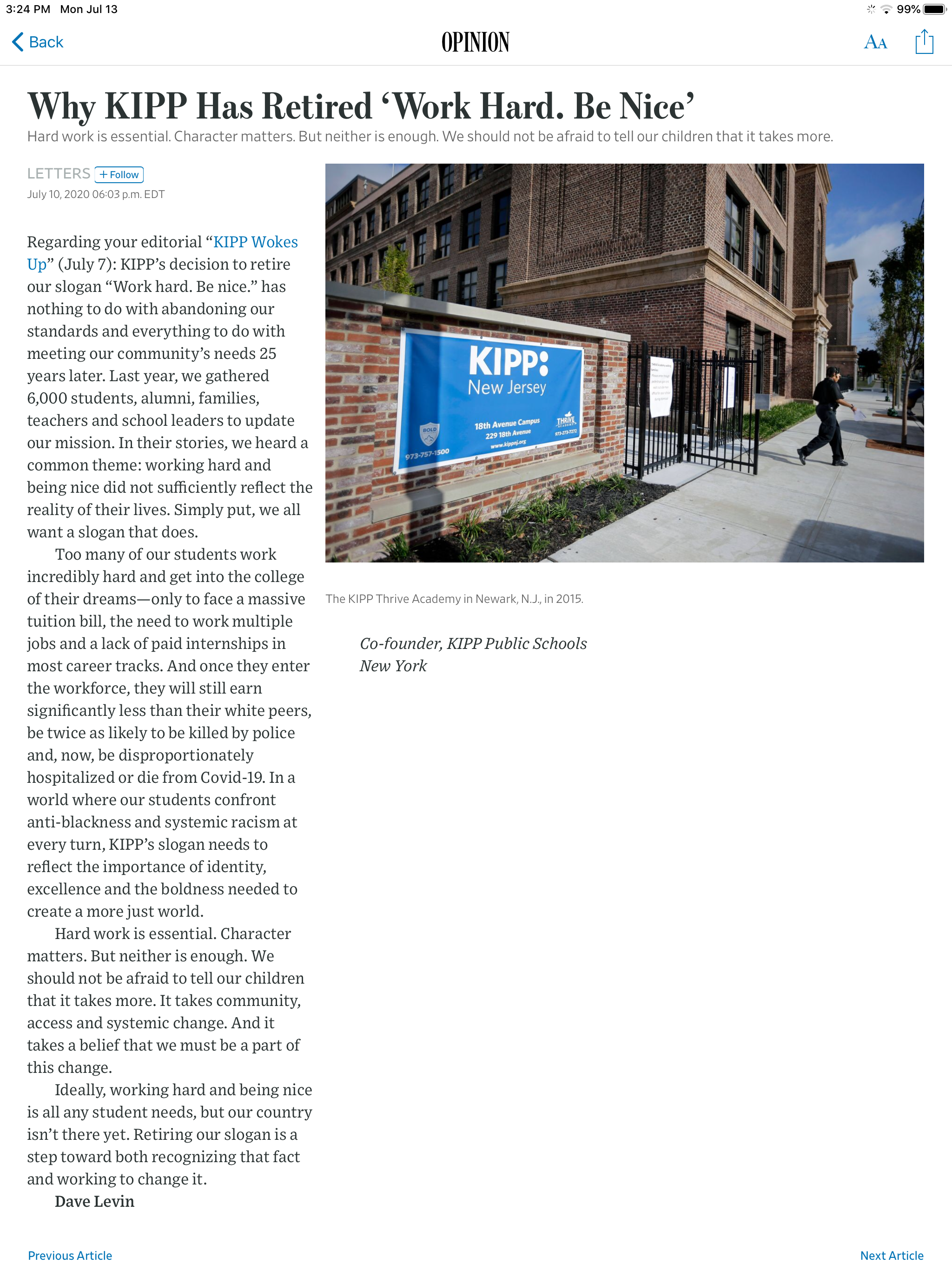
UPDATE: Three days after their editorial ran, the WSJ published a response from Dave Levin, Co-Founder of the KIPP Public Schools of New York. Given the circumstances, Levin’s response was surprisingly “nice.” He reinforced that hard work was, for most students, their reality, how after getting into the college of their dreams they still faced massive tuition bills, the need to work multiple jobs and a lack of paid internships, and once they entered the workforce, they will still earn significantly less than their white peers and be twice as likely to be killed by police. Levin said, KIPP believed that in a world where their students confront anti-blackness and systemic racism at every turn, that their slogan should reflect the importance of identity, excellence and the boldness needed to create a more just world. I can only hope that the editors at the Wall Street Journal were paying attention.
You can read the response here.