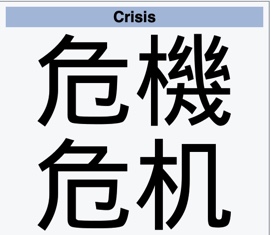
In the Chinese written language the character for crisis is a combination of two words that in Western cultures are frequently interpreted as representing both “danger” and “opportunity.” This is a misinterpretation that has been widely repeated in business, education and politics where it is often used as a rhetorical device – an optimistic “call to action” in times of crisis.
According to the experts, the first part of the character is correctly interpreted as “danger” or “precarious.” But the second part is something more like “change point,” which is a Chinese concept that doesn’t have a precise corresponding word in the English language. Somehow, in the Western translation “change point” morphed into “opportunity”.
This is interesting from an OD perspective, where “change” is a central focus of our work. One possible explanation for the misinterpretation is that the English language doesn’t have a very nuanced vocabulary for the concept of change. But I suspect it has more to do with the influence of American culture and its emphasis on gumption and resourcefulness.
This “misinterpretation” generates interesting questions like, how is connecting crisis with opportunity different from crisis being connected to change? How would it inform responding to a crisis? How would it affect the way the problem is defined, and the approaches to finding solutions, or the way a crisis is framed?
These are not just academic questions, they are central to how we think about change in everything from social problems that we experience in day-to-day life to important global issues like sustainability and climate change. And the misinterpretation brings to light the lack of a nuanced understanding of change in the Western culture and how change is often considered something to be resisted or feared.
Exploring the Chinese interpretation that connects crisis with a change-point opens the door to bringing an organization development mindset to crisis. It provides an entry point for systems thinking, challenging assumptions and integrating multiple perspectives into the way people solve problems and create value — things that are often under-appreciated in the leadership circles of organizations.
I’m not saying that the way crisis has been paired with opportunity is wrong-headed. Crisis does provide ways of seeing opportunities that are otherwise unseen or unexplored. But my main point is that it shouldn’t be an either/or proposition. Each perspective offers a different way of addressing the big challenges of the day. One is more about pursuing solutions that may create greater value or offer more advantages, the other incorporates the need to promote humanistic and democratic values in addressing crisis situations, and both are needed in order to build a better, more sustainable world.

 Hello, I'm Lisa Meyer