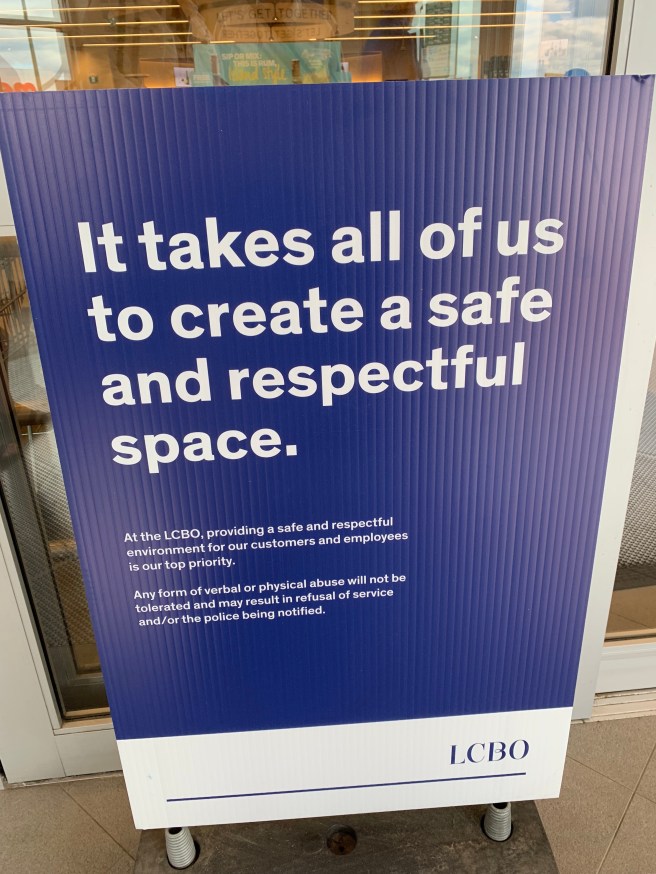
I took this picture last summer on a day trip to Thunder Bay, Ontario. We were traveling with friends and before we left town to return to their home on the north shore of Lake Superior in Minnesota, we stopped to check out the state-run liquor store in Thunder Bay. LCBO stands for Liquor Control Board of Ontario.
This sign sits prominently at the entrance to the store and it immediately caught my attention. I was impressed with the concept of creating “a safe and respectful space.” And with the words “all of us,” it places equal responsibility on owners, supervisors, employees, suppliers, shoppers- anyone in the space – for being responsible and accountable for their personal interactions and general behavior while in the store.
The language on the sign could be criticised for being too broad and vague to be enforceable. But what might be lost in this “soft” approach is gained back in how the statement leaves the definition of offensive behavior up to the person who does not feel safe or respected —giving voice to those who are affected by it.
The LCBO sign is quite different from the signage that greets visitors to businesses and public places where I live, in Minnesota. This has to do with how concealed carry of permitted handguns is allowed by Minnesota law. When this law was originally passed there were no restrictions as to where it applied so someone could take a permitted gun anywhere. However, there were challenges to this, first by churches and later by private businesses.
Now, the law reads that a private establishment may notify permit holders that firearms are not allowed in their building by posting signage that meets rigid specifications for size and content, like this sign at the Mall of America.
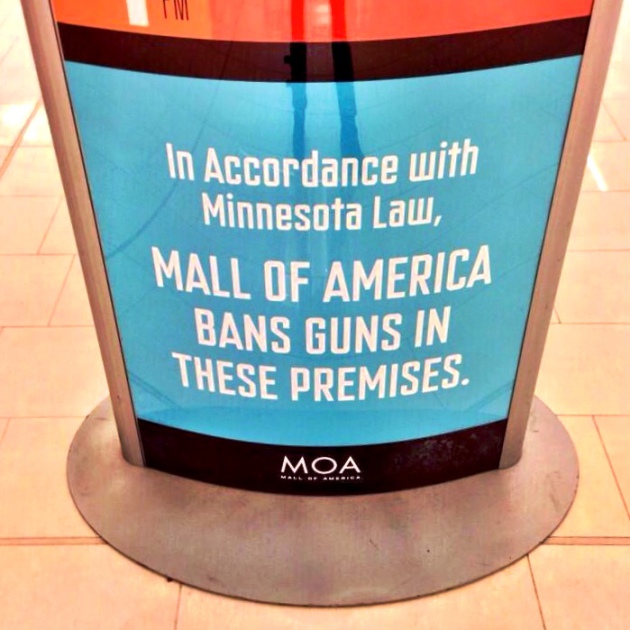
There are stark differences between the LCBO’s safe and respectful signage and Minnesota’s gun banning signs. The Canadian sign speaks to values and our collective humanity, the Minnesota sign speaks to a narrow legal restriction of individual rights. “Banning” is a statement that implies control and lawful compliance while “creating a safe and respectful space” implies a day-to-day commitment to a way of living.
Minnesota’s gun-banning signs are simply a transactional legal statement. They are not intended to communicate any further expectations about physical or verbal behavior. And because of this, there is also an implied message that says; this is all we have to say about the safety and comfort of those who pass through our doors.
Seeing the Canadian signage reminded me that there is so much more that organizations can do to elevate their commitment to safety and respect in their workplaces and gathering spaces. This goes way beyond just the banning of guns. It is in recognition of a societal responsibility to each other. It’s about sharing a common space with a concern for the basic human need to feel safe and respected while we are going about the daily business of life.
The Canadians have it right. It does take “all of us.”

 Hello, I'm Lisa Meyer