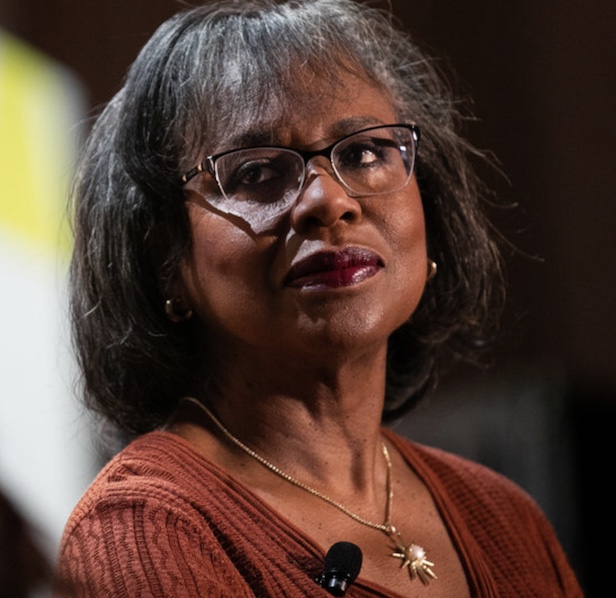
In June I was a delegate to the New York Times’ New Rules Summit that was held in Brooklyn, New York. This is an annual one-day event that brings together dozens of the most powerful and successful leaders across business, politics and culture to explore challenges faced by women in the workplace and how to bring about change. It was a great experience. The conference was extremely well organized and the agenda was packed, exploring the topic through a variety of lenses.
Leaving my hotel room on my way to breakfast, I stepped into the elevator and there standing next to me was Anita Hill who was scheduled to be the first speaker at the conference. I was struck by how little her appearance had changed since 1991 when this petite, quiet, Black woman, wearing carefully applied lipstick and a turquoise skirt suit, testified in front of a senate judiciary committee (comprised of all white men) about her experiences of sexual harassment while working for the Supreme Court justice nominee Clarence Thomas.
As you can tell from my description, there are certain details about the Thomas hearings that are still vivid in my memory. But, how I think about those hearings has changed, mostly because of the 2018 Senate confirmation hearings for Supreme Court Justice Brett Kavanaugh.
I am part of a cohort of professional women who witnessed both the Thomas hearings in 1991 and the Kavanaugh hearings in 2018. With this perspective, we have had to face the reality of how little has changed in those intervening years. And, as Anita Hill pointed out – how there was still no process for surfacing complaints, a “chilling effect” that prevented other accusers from coming forward, and a “thrown-together process” that still tended to favor the accused over the accuser.
On this matter, Anita Hill expressed her main desire, almost 28 years later; “that what we should want from our leaders is for someone or someone(s) to step up and say, what happened in 1991, what happened in 2018, will never happen again.”
Anita Hill talked about how she’s heard from people who really didn’t know that sexual harassment was illegal; that it had been so normalized in the the workplace that people just assumed that’s the way life is. Her reflections opened my mind to the realization that we still don’t have a good way to talk about sexual harassment, and all the many gender-based inequities in the workplace. She helped me see that this isn’t about a few bad apples but deeply embedded cultural problems and a social acceptance of those problems with legal structures, like nondisclosure agreements and forced mediation, that have been built to support it.
But looking at gender-based inequities as just a legal problem is short sighted. It’s a start, but when things get legal it’s generally too late. It’s better to step back to view the problem from the broadest range of perspectives we can. To look at gender-based inequities in the workplace as an ethical problem, a culture problem, a health and safety problem, a productivity, and economic problem.
Anita Hill said that after the Clarence Thomas hearings she was determined to not be the reason that prevented more people from coming forward. But she also talked about patience and taking the long view; to measure progress not through her lifetime, but through the lifetime of women, and what we can do for the next generation.
I am so grateful to have had the opportunity to hear Anita Hill reflect on her experiences and share her thoughts about the future. Her patient, quiet and laser-focused determination made a huge impression upon me and I intend to carry it forward in my own work.

 Hello, I'm Lisa Meyer